LSDs
Local Shape Descriptors for Neuron Segmentation
Sheridan et al., 2023
We developed a simple, yet effective, auxiliary learning task for the problem
of neuron segmentation in electron microscopy volumes.
The auxiliary task consists of the prediction of Local Shape Descriptors
(LSDs), which we combine with conventional voxel-wise direct neighbor
affinities for neuron boundary detection.
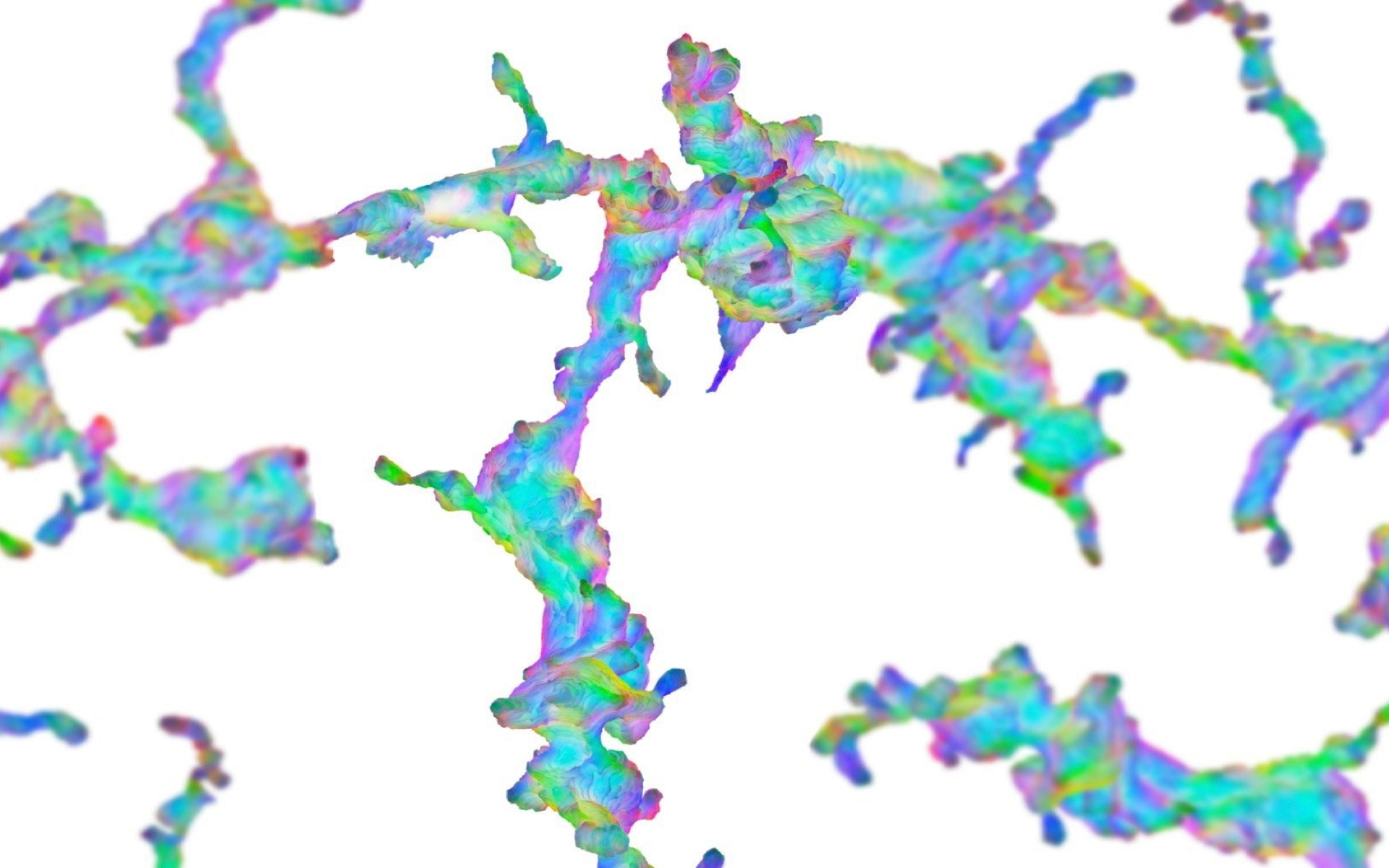
The shape descriptors are designed to capture local statistics about the neuron
to be segmented, such as diameter, elongation, and direction.
On a large study comparing several existing methods across various specimen,
imaging techniques, and resolutions, we find that auxiliary learning of LSDs
consistently increases segmentation accuracy of affinity-based methods over a
range of metrics.
Furthermore, the addition of LSDs promotes affinity-based segmentation methods
to be on par with the current state of the art for neuron segmentation
(Flood-Filling Networks, FFN), while being two orders of magnitudes more
efficient---a critical requirement for the processing of future petabyte-sized
datasets.
Implementations of the new auxiliary learning task, network architectures,
training, prediction, and evaluation code, as well as the datasets used in this
study are publicly available as a benchmark for future method contributions.
References
Local Shape Descriptors for Neuron Segmentation
Arlo Sheridan, Tri M. Nguyen, Diptodip Deb, Wei-Chung Allen Lee, Stephan Saalfeld, Srinivas C. Turaga, Uri Manor, Jan Funke
Nature Methods · 2023
DOI
Paper
Code
Website
Abstract
We present an auxiliary learning task for the problem of neuron segmentation in electron microscopy volumes. The auxiliary task consists of the prediction of local shape descriptors (LSDs), which we combine with conventional voxel-wise direct neighbor affinities for neuron boundary detection. The shape descriptors capture local statistics about the neuron to be segmented, such as diameter, elongation, and direction. On a study comparing several existing methods across various specimen, imaging techniques, and resolutions, auxiliary learning of LSDs consistently increases segmentation accuracy of affinity-based methods over a range of metrics. Furthermore, the addition of LSDs promotes affinity-based segmentation methods to be on par with the current state of the art for neuron segmentation (flood-filling networks), while being two orders of magnitudes more efficient—a critical requirement for the processing of future petabyte-sized datasets.